
How to Get Rid of Textured Acne Scars
A Guide to Acne Scar Management in Milton Keynes
Acne may have cleared, but the marks it leaves behind can sometimes feel harder to move on from. Pitted areas, uneven texture and lingering discolouration can remain long after active breakouts have settled, and skincare alone may only go so far.
If you are researching acne scar management in Milton Keynes, the first thing to know is that acne scars cannot always be completely removed. However, their appearance can often be significantly improved with the right professional treatment plan.
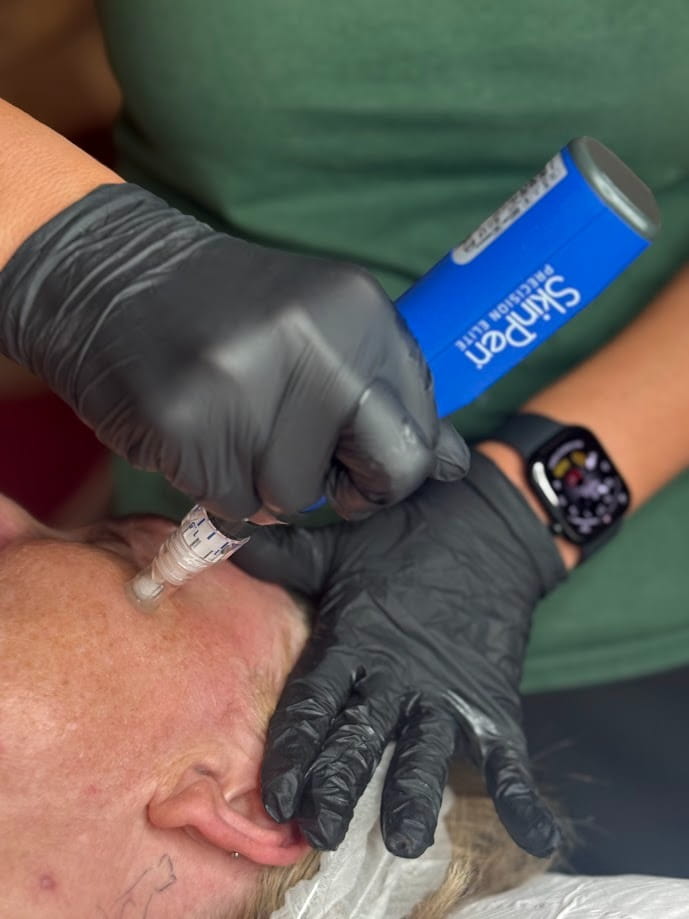
We recommend microneedling for textured, indented acne scarring, as it is one of the most recognised treatment options used to stimulate collagen and encourage gradual skin remodelling. We have introduced SkinPen microneedling to our clinic, offering a professional option for clients whose main concerns are residual scarring, uneven texture, and overall skin quality.
The important part is knowing what type of acne scarring you have and whether microneedling is the right approach for it.
Can You Completely Get Rid of Textured Acne Scars?
The short answer is not always, but you can often make them much less noticeable.
A true acne scar is a structural change in the skin. When deeper acne causes inflammation and damage, the healing process may produce too little or too much collagen. If too little collagen is produced, the skin can heal with a depression or indentation.
There are three common types of indented acne scars: ice pick scars, rolling scars and boxcar scars. Deeper spots, such as nodules and cysts, are more likely to cause scarring.
That is why a cream cannot simply “erase” a textured scar. Improving it usually means encouraging changes within the skin itself.
Professional treatments such as microneedling work differently from everyday skincare because they stimulate a controlled repair response and new collagen formation. Over time, this can help scars look softer and the skin surface appear smoother.
The realistic goal should therefore be improvement rather than perfection.


Is It Actually A Scar Or A Mark Left By Acne?
Before deciding how to fade acne scars, it helps to work out what you are actually seeing.
People often use “acne scars” to describe any mark that remains after a breakout, but there is an important difference between changes in colour and changes in texture.
A flat brown, red or darker mark may be post-inflammatory pigmentation or discolouration rather than an indented scar. A true atrophic acne scar changes the contour of the skin.
You may also have both at the same time.
For example, you might notice:
- a shallow indentation accompanied by a darker mark
- an uneven or rippled texture across the cheeks
- deeper individual pits
- areas where the skin looks smooth from one angle but uneven when light hits it
- residual pigmentation without any indentation at all
This distinction matters because no single acne scarring treatment is ideal for every concern.
Microneedling can be useful for uneven texture and atrophic scarring and may also improve aspects of uneven skin tone. However, pigmentation may sometimes need its own targeted approach.

What Causes Pitted & Textured Acne Scars?
Textured acne scars usually develop because the skin’s healing process has been disrupted by inflammation.
When acne penetrates deeply into the skin, surrounding tissue can become damaged. Your body then tries to repair that damage with collagen.
If there is not enough collagen to replace the lost tissue, a depression can remain.
Picking, squeezing or scratching acne can increase the likelihood of scarring because it causes additional trauma to already inflamed skin.
Unfortunately, even somebody who has been extremely careful with their skin can still develop acne scars. The severity and depth of the original acne also play an important role.
What Are The Different Types Of Textured Acne Scars?
Not all pitted acne scars are structurally the same.
Understanding the main types helps explain why the best treatment for acne scars can differ from one person to another.
Rolling scars create shallow, wave-like depressions across the skin. Rather than having sharply defined edges, they can make the surface appear rippled or uneven.
These are often particularly noticeable in side lighting.
Boxcar scars tend to be round or oval depressions with more defined edges.
They can vary in depth, from relatively shallow indentations to deeper scars.
Ice pick scars are narrower and deeper, creating small but pronounced pits in the skin.
These deeper scars can be more difficult to improve with microneedling alone.
Many people do not have just one type. Mixed acne scarring is common, which is another reason we favour a consultation-led approach rather than assuming one treatment will solve everything.


Why Does Skincare Struggle To Smooth Pitted Acne Scars?
A good home skincare routine is still valuable. It can support healthy skin, improve hydration, protect against UV damage and help manage concerns such as pigmentation.
What it generally cannot do is rebuild a significant depression in the dermis by itself.
Textured acne scars involve changes below the skin’s surface, so repeatedly changing exfoliants, serums or trending products may leave you frustrated if the main concern is structural scarring.
That does not make skincare pointless. In fact, appropriate home care can be an important part of preparing the skin for professional treatment and maintaining results afterwards.
The key is matching the solution to the problem.
If the issue is pigmentation, you may need a pigmentation-focused plan.
If active acne is still the main concern, controlling the breakouts usually needs to come first.
If the acne has settled and you are left primarily with pitted or uneven texture, a collagen-stimulating treatment may be more appropriate.
How Can SkinPen Microneedling Improve Textured Acne Scars?
SkinPen is a professional microneedling device designed to create precise, controlled microchannels in the skin.
Those controlled micro-injuries trigger the skin’s natural wound-healing response. As part of that process, the body produces and reorganises collagen and elastin.
This is why microneedling is also known as collagen induction therapy. The aim is not to fill a scar instantly. Instead, treatment encourages gradual remodelling of the skin so that depressed scars can become less noticeable and overall texture can appear smoother.
SkinPen has also been specifically studied for facial acne scarring. Its clinical study evaluated a course of three treatments, performed approximately one month apart, followed by assessment after the final treatment.
For someone looking at SkinPen microneedling because old acne has left their skin uneven, the main benefits we are interested in are:
- gradual collagen stimulation
- improvement in uneven skin texture
- softening the appearance of suitable indented scars
- supporting smoother-looking skin
- improving overall skin quality
- helping address uneven tone where appropriate
It is a process rather than an overnight transformation.
Which Acne Scars Can SkinPen Help Most?
Microneedling is commonly used for atrophic acne scars, meaning scars where tissue has been lost and an indentation has formed.
Scar depth, age, location, skin condition and individual healing all matter.
It is also important to distinguish indented scarring from raised hypertrophic or keloid scars. Those require a different assessment and treatment strategy.
This is one of the reasons searching for “the best acne scar treatment near me” should ideally lead to an assessment rather than immediately booking whichever treatment appears most popular online.
The best treatment is the one that matches your scar type and your skin.
What If You Still Have Active Acne?
This is an important point that is sometimes overlooked.
If you still have inflamed, painful or pus-filled acne in the area, treating the scars may not be the first priority.
Professional microneedling should not simply be performed over active inflammatory lesions.
It also makes little sense to focus entirely on old scars while new breakouts continue to create the risk of further scarring.
We would rather look at the bigger picture.
For someone dealing with both breakouts and the marks left behind, our blemish and acne guidance and personalised consultation process can help establish what should be addressed first.
How Many SkinPen Treatments Might You Need For Acne Scarring?
Acne scar improvement generally requires a course rather than a single treatment.
There is no responsible way to give every person the same number because treatment plans depend on factors including:
- scar type
- scar depth
- the size of the area
- overall skin health
- whether pigmentation is also present
- how your skin responds between treatments
- your realistic treatment goals
At consultation, we can assess the scarring and explain what a realistic treatment journey may look like for your skin.
Microneedling is not an instant resurfacing treatment.
Some people may notice their skin looking fresher or smoother relatively early, but the changes associated with collagen remodelling develop over a longer period.
That gradual process is worth understanding before treatment.
Instead of asking, “What will my skin look like tomorrow?”, a more useful question is:
“What could consistent treatment and good home care achieve over the coming months?”
For long-standing scarring, patience is part of the process.
Potentially, but pigmentation and scarring should not be treated as the same concern.
If pigmentation is the dominant concern and the skin itself is relatively smooth, a different treatment plan may be more suitable than approaching the issue purely as acne scarring.
This is especially important because colour changes following acne can vary significantly between skin types.
At McCarthy Skin Clinic, we can consider pigmentation alongside texture rather than treating each feature in isolation. Where pigmentation is a significant part of the concern, our information on pigmentation treatments explains some of the other options that may form part of a personalised plan.
This is another useful question because microneedling is not a single treatment format.
Traditional professional microneedling uses controlled needling to stimulate the repair response.
Radio frequency microneedling combines this needling action with radio frequency energy delivered into the skin.
Both approaches can support collagen remodelling, but they are not interchangeable and one is not automatically “better” for everybody.
We offer both SkinPen and microneedling with radio frequency using Dermaforce. We have also explored the differences in our guide to SkinPen vs Dermaforce.
The choice should come back to your skin, your scarring and what we are trying to achieve.
Why A Personalised Acne Scar Treatment Plan Matters
The most useful starting point is not deciding that you “need SkinPen”.
It is understanding what has actually been left behind by your acne.
During a skin consultation, we can look at factors such as:
- whether your acne is still active
- whether the main concern is texture, pigmentation or both
- the types and depth of scarring
- your current skincare
- your treatment history
- your goals and expectations
- whether SkinPen is appropriate or another approach should be considered
For more complex or long-standing concerns, treatment may also form part of one of our personalised Skin Transformation Programmes, where professional treatments and home care can be planned together rather than approached as disconnected appointments.
That is particularly useful when acne has left more than one concern behind.
Start With The Scar, Not The Treatment
If acne has left you with uneven texture, pitted scarring or pigmentation, you do not have to keep guessing which product or treatment to try next.
The first step is understanding exactly what is happening in your skin.
At McCarthy Skin Clinic, we take a personalised approach to acne scarring rather than assuming every client needs the same treatment. If SkinPen is appropriate, we can explain what it may realistically achieve, what kind of treatment course may be needed and how to support your skin throughout the process.